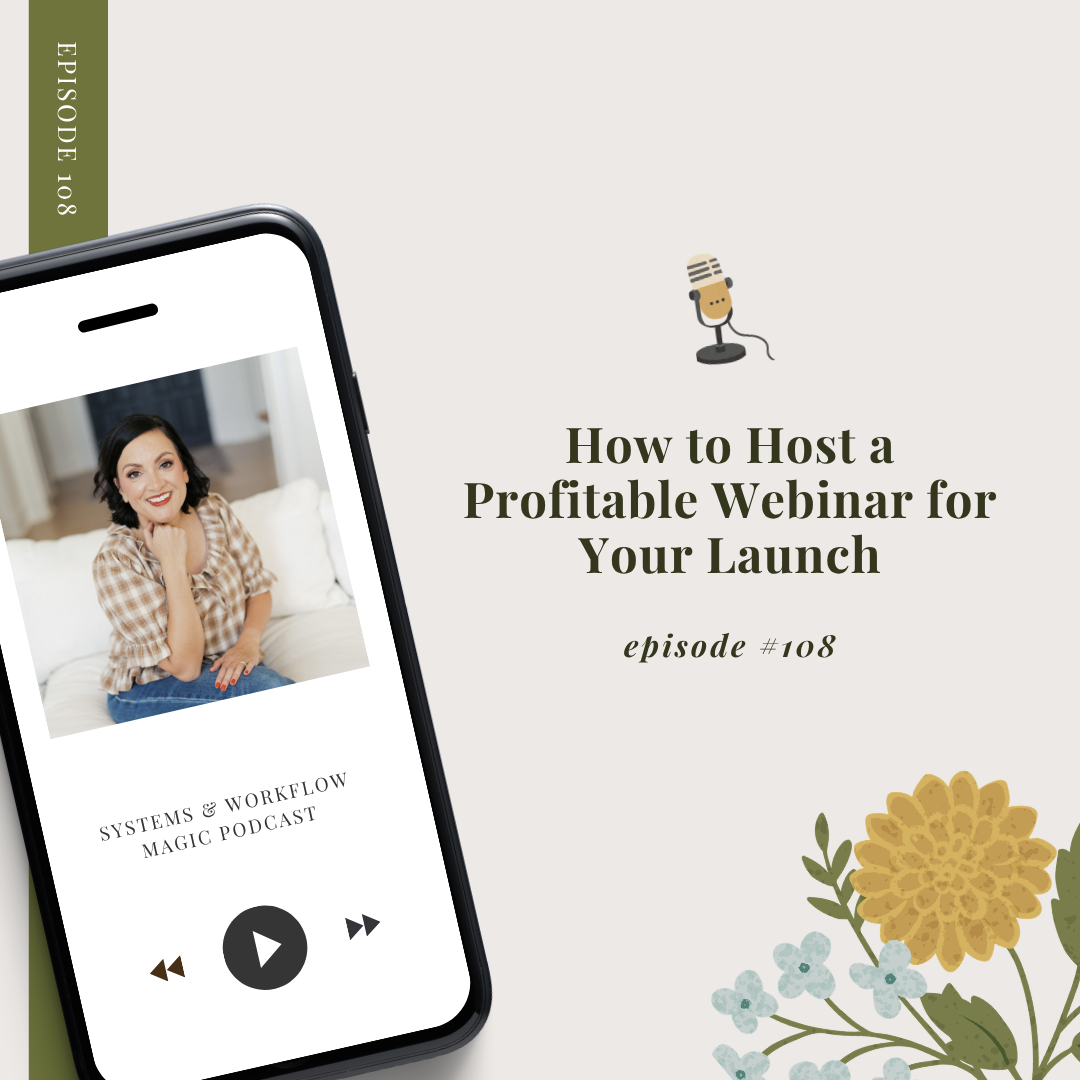
How to Host a Profitable Webinar for Your Launch Featuring Mara Kucirek
Note: This blog post was originally based on a podcast episode recorded in late 2023. Some platform-specific details may have changed, but the strategy and principles remain highly relevant. You spent months creating your course, digital product, or membership. You wrote the sales page. You built the email sequence. And now you are staring at a launch runway that feels… quiet. If this sounds familiar, you are not alone. One of the most effective (and often overlooked) ways to warm up your audience before cart open is to host a profitable webinar or masterclass tied directly to your launch. This post breaks down exactly how to plan a webinar that grows your email list, re-engages your current subscribers, and drives more sales during launch week. These tips come straight from a conversation I had with Mara Kucirek, an online course designer and launch strategist who has helped clients of all sizes run webinars that convert. I am sharing the real strategy here so you can apply it to your next launch, whether it is a digital product, a mini-session offer, or a full course. If you are looking for a repeatable system to make launching feel less chaotic, I have a resource for that. Grab The Family Photographer’s Workflow Blueprint to organize the behind-the-scenes of your business before you go live with anything.
Listen to this podcast episode here 🎙️
Watch this interview on YouTube 🎥
Continue to read the Blog post here ⬇️
Should You Host a Webinar Before Your Launch?
A pre-launch webinar re-engages your current email list, grows your subscriber count, and gives potential buyers a taste of your teaching style before the cart opens. The short answer is yes, with one condition: it should not stress you into skipping the launch entirely. A webinar or masterclass (or “free training” or “workshop,” because these terms all mean the same thing) is one of the strongest tools you have for warming up an audience. It gives people a real teaching moment with you, not a pitch-fest, and it builds trust that makes buying feel like a natural next step. Here is what a well-timed webinar does for your launch:
- Grows your email list with people who are genuinely interested in your topic
- Re-engages subscribers who may have tuned out of your regular emails
- Positions you as a credible teacher, not just a seller
- Creates an evergreen asset you can repurpose long after launch week ends
If hosting a live class is going to derail your entire launch plan, it is fine to skip it and add one to your next launch instead. There is no rule that says every launch needs a webinar. But if you can make the time, the ROI is worth the effort. Want to build a marketing system that keeps your audience warm between launches? Check out The Family Photographer’s Marketing Society for weekly marketing plans built for solo photographers.
What Should Your Webinar Topic Be About?
Choose a topic that teaches the very first step someone would need to take before buying your paid offer, and give your audience a small, specific win they can complete in under 30 minutes. Your webinar topic should connect directly to what you are selling. If you are launching a course on Dubsado workflows, your masterclass might teach how to set up one specific automation inside Dubsado. If you are launching a mini session marketing guide, your webinar could walk people through writing their first promo email. The goal is a bite-sized win. After the class, attendees should be able to take one action within 15 to 30 minutes that yields a tangible result. That result builds their confidence and shows them what is possible when they go deeper with your paid offer. A big mistake here (and I am raising my own hand) is overteaching. When you pack too much homework into a free training, your audience leaves feeling overwhelmed instead of excited. They think, “I need to finish all of this before I’m even ready to buy.” That is the opposite of what you want. Think of it this way: teach your audience as if they were middle schoolers with short attention spans and ten competing priorities. Keep the homework simple, the teaching focused, and the energy high. If you are stuck on topic ideas, poll your email list or your Instagram audience. Ask them what they want to learn from you for free. Let your people do the brainstorming for you. If you want more ideas for creating lead magnets and free trainings that tie into your offers, grab The Lead Magnet Master Idea List. It is free, and it will give you a running start.
How Much Time Do You Need to Prep a Webinar?
Give yourself at least one month to plan your webinar content, build your signup page, create slides, and promote the event to your audience. Most people come up with a webinar idea and schedule it for the following week. Then it turns into a scramble of slides, signup forms, and last-minute Canva graphics. A month of lead time gives you space to:
- Nail your topic and make sure it connects to your paid offer
- Create a simple signup page (your email marketing tool can usually handle this)
- Build your slide deck (aim for 20 minutes of teaching content)
- Run through it once with a friend or business buddy to test the tech
- Promote the class across your email, social media, and anywhere your audience spends time
Speaking of promotion: one mention is never enough. Your audience is busy. They are juggling client sessions, editing queues, kids, and life. You will need to talk about your free class multiple times across multiple platforms before people even register. And even after all of that, someone will still say, “Wait, I didn’t know you were doing a class on that.” That is normal. Keep showing up. Need a system for organizing your marketing tasks during a launch? The Backend Organization System for Family Photographers is a Trello-based board that keeps all the moving pieces in one place.
What Tech Do You Actually Need to Host a Webinar?
You need a Zoom account (the paid plan to ensure you can record), a signup page in your email marketing tool, and a friend or VA to monitor the chat. That is it. Please do not let the tech scare you away from hosting a webinar. You do not need fancy webinar software. You do not need a $200/month platform. A simple Zoom meeting (not even the Zoom “webinar” tier) works perfectly well for most business owners, even those with larger audiences. Here is the bare-bones tech stack:
- Zoom (paid plan): So you can record reliably. Set your Zoom to auto-record so you never forget to hit the button. You can always trim the beginning later.
- Your email marketing tool (like Flodesk): Use it to build your registration page and send reminder emails.
- A chat buddy: Ask a friend, a fellow photographer, or a VA to sit in your webinar and drop links in the chat, answer tech questions, and hype up the energy. Give them a list of 5 to 10 links people might ask about (your website, podcast, sales page, freebie, etc.) so they are ready.
That last point is more valuable than you think. When you are in teaching mode, you cannot troubleshoot someone’s audio issues and paste your sales page link at the same time. Having one person dedicated to the chat lets you stay focused on delivering a great class.
How Do You Get People to Watch the Replay?
Send multiple reminder emails, keep the replay available for a limited time, and include a specific reason for watching in your follow-up messages rather than a generic “here’s the replay” link. Not everyone can attend live, and that is expected. The replay is where a large portion of your views (and sales) will come from. But getting people to actually watch a replay is harder than getting them to show up live. You need to give them a reason beyond “in case you missed it.” Try these approaches:
- Create urgency by making the replay available for a limited window (72 hours works well)
- Highlight a specific moment in the replay that answers a burning question (“At the 14-minute mark, I break down exactly how to write your first promo email”)
- Include a live-only or replay-only bonus to incentivize watching
- Send 2 to 3 follow-up emails after the webinar, not just one
If you want to build stronger email sequences that actually get opened, you will love the tools and strategy inside The Blogging and Organic Visibility System for Family Photographers. It covers how to create content that keeps working for you long after publish day.
How Do You Sell During the Webinar Without Being Pushy?
Tell your audience at the beginning of the class that you will share an offer at the end, teach valuable content for the first 20 to 40 minutes, and then present your paid offer as a natural next step. Nobody wants to sit through a 60-minute infomercial disguised as a free class. The best webinars teach something real and then make a genuine offer at the end. Here is what that looks like in practice: At the start of your webinar, let your audience know what to expect. Say something like, “I am going to teach you [specific thing] for the next 30 minutes, and at the very end, I will share how we can keep working together if you want to go deeper. No pressure at all.” This kind of transparency builds trust. People actually stay longer when they know what is coming because curiosity kicks in. During the teaching section, focus on delivering a real win. Do not hold back value just to “save it” for the paid offer. Your paid offer should go deeper, not wider. The free class gives them the first step; the paid offer gives them the full system. At the end, present your offer as the logical continuation. “If this was helpful and you want the complete workflow, here’s where you can get it.” Keep it simple. Keep it honest. You do not need to be a used-car salesperson. Pro tip: Offer a small bonus for anyone who buys while you are live. A bonus coaching call, an extra template, or early access to a module. This creates a reason to act now, rather than “thinking about it” for the next two weeks and then forgetting.
How Can You Repurpose Your Webinar After the Launch?
Turn your recorded webinar into an evergreen lead magnet, a private podcast series, a YouTube video, or a collection of blog posts built around the subtopics you covered. One of the biggest advantages of hosting a webinar is that the content does not expire when your launch ends. A single recorded masterclass can become:
- An evergreen opt-in where new subscribers sign up and watch the replay on demand (just remove the live date from your signup page and note that it is pre-recorded)
- A private podcast episode that people can listen to while driving or editing photos
- Multiple blog posts based on the subtopics you covered (like this very post you are reading)
- A paid product down the road, which makes your audience feel great about the value they got for free
One important note: refresh your webinar content at least once a year. Update outdated stats, swap old screenshots, and re-record if your offer or pricing has changed. There is nothing worse than opting into a “free training” and realizing the presenter’s kid was a baby when they recorded it and is now in fourth grade.
Frequently Asked Questions About Hosting a Profitable Webinar
What is a good conversion rate for a webinar? Across the board, a 1% conversion rate is considered strong. Smaller, more connected audiences often see higher conversion rates because the relationship is tighter. Do not compare your first webinar numbers to those of someone who has run the same class 10 times. What if only a few people show up to my webinar? Five engaged attendees who ask questions can drive more sales than 50 passive viewers. Mara Kucirek has worked with business owners who had five live attendees, and all five bought. The replay will also capture people who registered but could not attend. Should I charge for a pre-launch masterclass? For a launch-focused webinar, free is the move. The purpose is to grow your list, build trust, and warm people up for the paid offer. You can always turn the recording into a paid product later. How long should a webinar be? Aim for 20 minutes of core teaching. With introductions, Q&A, and your offer pitch, the total will naturally stretch to 40 to 60 minutes. Avoid going over 90 minutes. People have lives, dinners to cook, and kids to wrangle. Can I run the same webinar more than once? Yes, and you should. Each time you teach the same material live, you get better. You anticipate questions, tighten your slides, and feel more confident. Repeating a webinar is one of the smartest ways to improve your conversion rate without creating new content from scratch.
Your Next Step + Conclusion
Hosting a profitable webinar does not require a massive email list, expensive software, or a polished presentation style. It requires a focused topic, a simple tech setup, and the willingness to show up and teach something your audience genuinely needs. Start with one webinar. Record it. Repurpose it. And then do it again. And if you want to keep learning about launching, marketing systems, and workflows for your photography business, subscribe to the Systems and Workflow Magic Podcast wherever you listen.
Meet Your Favorite Marketing Strategist and Business Coach for Family Photographers (Dolly DeLong Education)

Hi, I’m Dolly DeLong, a Nashville-based family photographer, marketing strategist, and systems educator for family photographers who want structure, clarity, and consistency in their marketing.
My photography journey began in 2006, and over the years, I built a sustainable family photography business while navigating motherhood, client work, and the realities of running a solo creative business. Along the way, I discovered something unexpected: I loved the backend just as much as the creative side.
What started as organizing my own workflows turned into helping other family photographers simplify their marketing, build repeatable systems, and stop relying on last-minute posting or panic marketing.
Today, I focus exclusively on helping family photographers intentionally market their businesses (not with trends but with consistently showing up).
I offer two ways to work with me:
-
The Family Photographer’s Marketing Society: a systems-first membership that provides a clear weekly marketing cadence for Instagram and email, so you always know what to focus on without starting over.
-
1:1 Strategic Marketing Support for established family photographers who want hands-on guidance in building a sustainable, SEO-supported marketing system.
Through my blog, podcast, and YouTube channel, I teach family photographers how to think like marketers, plan ahead, and create marketing rhythms that support both their business and their family life.
I still photograph families around Nashville because it’s one of my greatest joys. But helping family photographers build calm, consistent marketing systems that actually fit real life is a close second.
I’m so glad you are here, reading this blog, listening to the podcast, or watching the embedded YouTube video. I hope this educational content was helpful. Please let me know what future systems content you would like me to create!
more on me • more on me

More about dolly
Hi, I’m Dolly — a family photographer, marketing strategist, and systems & workflow educator for family photographers who want to find joy (and order) in their business again. Because I still work behind the camera, I understand firsthand how overwhelming the backend of a creative business can feel.
With my launch-strategist brain and a deep love for simple systems, I help photographers build intentional marketing rhythms and workflows that make it easier to show up consistently, attract the right clients, and actually enjoy running (and marketing) their business.
Through my blog, podcast, and YouTube education, I share actionable steps, real talk, and encouragement — all rooted in faith and intention — to help you bring clarity and confidence to your marketing and everyday systems. Because sustainable growth isn’t built on hustle or speed, but on thoughtful planning, consistency, and care.
part cheerleader. part systems guide.
But all dolly.
I'm Dolly

Watch now
This training covers the elements you should include in your photography business contact form.
How to create a contact page that WOWS & converts
no 03. | free training

Download now
Access my exact checklist I use to create my mini sessions every year in Dubsado
The Dubsado
Mini-Session Master Workflow Checklist
no 02. | DOWNLOAD

Get the free guiide
These evergreen posts build confident & consistent marketing
5 Instagram posts every family photographer should be sharing
no 01. | download