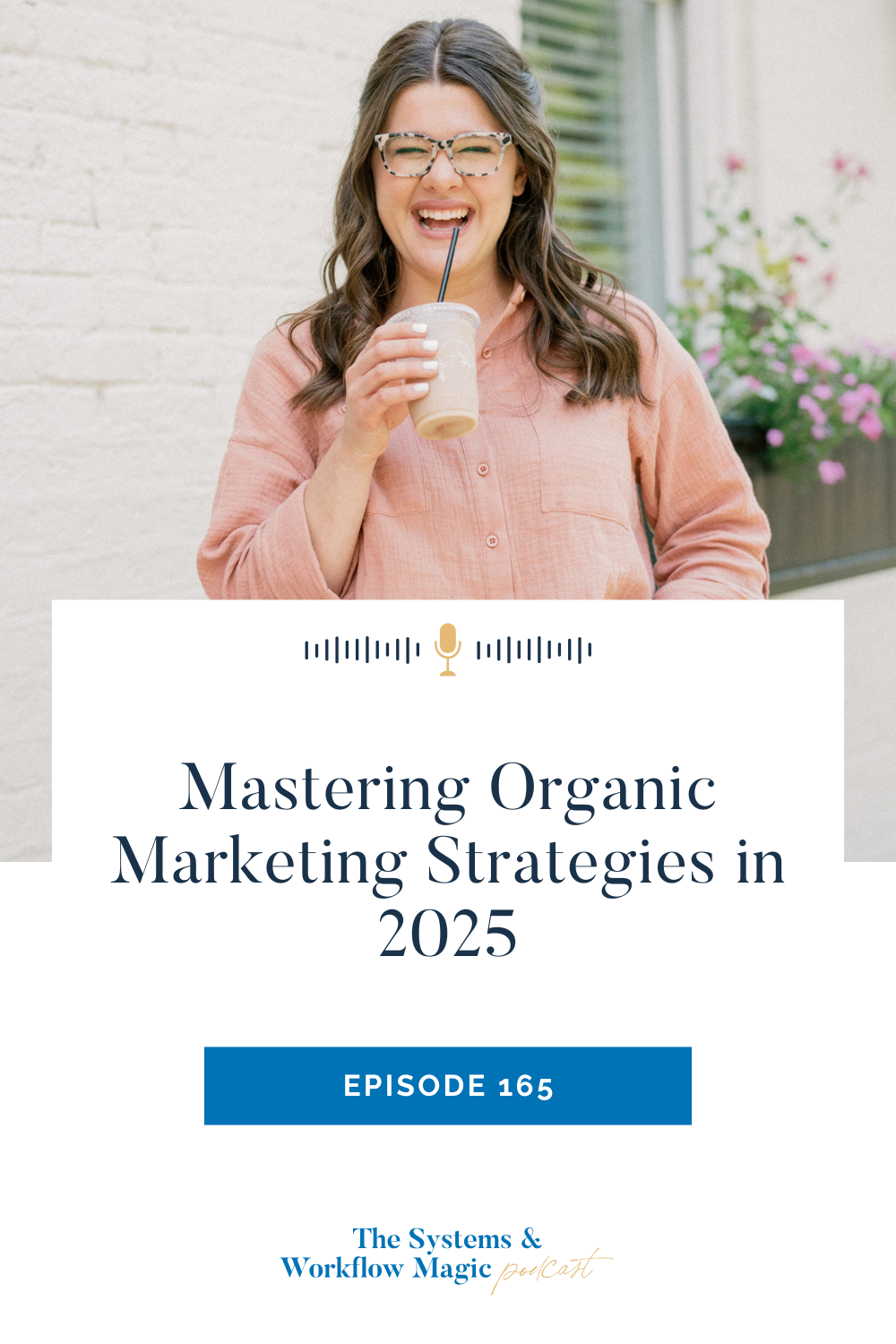
Mastering Organic Marketing Strategies for 2025 with Stephanie Kase
As a solo business owner, growing your business can feel overwhelming—especially when you’re trying to market effectively without a big budget for paid ads. But here’s the thing: organic marketing isn’t just about saving money—it’s about building authentic connections, creating a sustainable system, and setting your business up for long-term growth. This approach allows you to focus on your audience, avoid unnecessary distractions, and develop strategies that align with your goals.
In this week’s episode of the Systems and Workflow Magic Podcast, I’m thrilled to feature Stephanie Kase, a business educator and organic marketing expert. Stephanie shares actionable strategies to master organic marketing in 2025, including how to connect with your ideal audience, build a strong foundation for your marketing efforts, and leverage platforms that work best for your business. Whether you’re just starting out or looking to refine your existing strategies, you’ll walk away with practical tips to elevate your marketing game.
We’ll also discuss why deepening your understanding of your audience and focusing on one platform at a time can make all the difference in creating a sustainable, impactful marketing strategy. If you’ve ever felt overwhelmed by all the options out there or unsure about how to build momentum with your marketing, this episode is for you!
Ready to transform your marketing plan and build a system that works for you in 2025? Hit play on your favorite podcast app, or click the link in the show notes to dive in!
🗒️Review the Show Notes & Quick Links From Episode 165🎙️
Want A Blog Version Of This Podcast? Here Ya Go ⬇️
Please note: This post was originally published in early 2025 and draws from a real conversation with organic marketing educator Stephanie Kase. The strategies covered here are rooted in timeless marketing principles that still apply today. Some platform-specific details may have evolved, but the core framework is as relevant as ever. Read on!
What If Your Marketing Could Work While You Were Editing a Gallery?
You shoot a session on Saturday morning, come home, and by Sunday afternoon, you have two new inquiries sitting in your inbox. Not because you ran a Facebook ad. Not because you posted five Reels that week. But because your content was already out there, working quietly in the background.
That is what organic marketing can do. And no, it is not a fantasy.
This post breaks down the organic marketing strategies family photographers used in 2025 to consistently book clients, straight from a conversation with Stephanie Kase, online business educator and the woman behind the Online Marketing Club. You are going to walk away with a clear starting point, practical steps, and a strategy that actually fits your real life as a solo photographer.
What Is Organic Marketing for Family Photographers?
Organic marketing means reaching your ideal clients through content, SEO, social media, and email rather than paying for ad placements.
Organic marketing includes strategies like blogging, social media content, email marketing, SEO, and YouTube. It helps photographers build trust with potential clients without relying on a paid ad budget.
For solo family photographers, that distinction matters a lot. You are already wearing every hat in your business. Adding a paid ads budget on top of that, without a solid foundation underneath, is like putting frosting on a cake that has not finished baking. You end up frustrated, spending money, and wondering why it is not converting.
Organic marketing builds that foundation first.
Stephanie described it perfectly: “It really lays a lot of that foundational work. A lot of it goes back to those timeless things, like building out your brand messaging, knowing how to write strong copy, knowing how to speak to your ideal client.”
That is the move.
Why Does Organic Marketing Work Better Long-Term?
Organic marketing creates content that keeps generating traffic, leads, and bookings long after you publish it, unlike paid ads that stop the moment you stop spending.
Stephanie shared that she still gets thousands of views from YouTube videos she posted back in 2021. Years later. That is the compounding effect of evergreen content, and it is the reason organic marketing is worth every ounce of effort you put in.
Paid ads can speed things up once you know your ideal client and your messaging inside out. But if you skip the organic foundation and go straight to ads? You are spending money to amplify a message that has not been tested. You could book clients through ads and have no idea why it worked or how to repeat it.
Organic marketing gives you the data and the confidence first.
Where Should a Family Photographer Start with Organic Marketing?
Start with one short-form, timely platform like Instagram, master it, and then add a long-form evergreen platform like a blog or YouTube as a second layer.
Stephanie’s advice was clear: do not try to be everywhere at once. “Start with one platform and see momentum with that before you start to expand.”
Here is what that looks like in practice:
Step 1: Know your ideal client deeply. Not just “married women in their 30s.” Think about what they are searching for, what they are worried about, and what they would type into Google at 10 pm when their toddler is finally asleep, and they are trying to find a photographer for spring mini sessions. Write it down. Get specific.
Step 2: Choose one short-form platform. Instagram and TikTok are the go-tos here. These platforms let you reach people quickly and build connections fast. The downside is that short-form content has a short shelf life, usually 24 to 48 hours. That is why it is only part of the strategy, not the whole thing.
Step 3: Add a long-form, evergreen platform as your second layer. A blog or YouTube channel is where your content lives forever. You write one post about what to wear for a fall family session, optimize it for search, and that post can bring you inquiries for three, four, or five years. That is the kind of marketing that works while you sleep.
Step 4: Create a simple content plan. Balance short-form and long-form so your marketing builds momentum now AND compounds over time.
Want a system for all of this? The Family Photographer’s Workflow Blueprint walks you through building a workflow for your family photography business that runs with structure and intention.
How Does SEO Fit into an Organic Marketing Strategy?
SEO helps your blog posts, website pages, and videos appear in search results when potential clients type in questions related to your photography services.
Here is the real-world version: a family in your city types “best family photographer in Nashville for toddlers” into Google. If your blog post answers that search query well, you show up. You did not pay for that click. You earned it.
Stephanie used this exact strategy to book wedding clients when she moved to a new city and knew nobody. “I wrote blog posts and got my website ranked for different search terms my ideal clients were searching in Google. That is how I booked a lot of my clients.”
For family photographers, SEO is one of the most powerful long-game tools available. And blogging is the vehicle that makes it happen. If you have been sitting on the fence about starting a blog, OH M GEEEE, this is your sign.
What Kind of Content Should Family Photographers Create?
Family photographers should create a mix of short-form content on social media for quick connection and long-form evergreen content like blog posts or YouTube videos for lasting visibility and SEO.
Think of it this way: Instagram is like a conversation at a coffee shop. It is warm, it is quick, and people feel connected to you fast. A blog post is like leaving a note taped to the window of that coffee shop. Long after you have left, people are still finding it and reading it.
You need both.
Short-form content builds trust now. Long-form evergreen content books clients later. Together, they create a marketing system that compounds over time rather than constantly starting from zero.
Here is a simple content framework to consider:
Social media posts: Client education, behind-the-scenes, quick tips, personal connection
Blog posts: Session galleries, location guides, “what to wear” content, photography tips for families
Email marketing: Nurture your list with helpful content, session availability, and offers
What If You Are a Local Service Business, Not an Online Business?
Local service businesses like family photographers can use the same organic content strategies paired with local SEO to attract clients in their geographic area.
Stephanie made a great distinction here. If you serve clients in person and locally, your strategy is not entirely the same as someone selling digital products. You absolutely can use organic marketing, but you want to layer in local SEO. That means your blog posts should reference your city, your locations, and your neighborhoods. Think “family photographer in Brentwood, TN,” not just “family photographer.”
Referrals and in-person networking matter too. But online organic marketing gives you visibility that works 24 hours a day, even when you are off the clock.
How to Build a Sustainable Organic Marketing Plan
A sustainable organic marketing plan includes knowing your ideal client, choosing one platform to start, creating a mix of short-form and long-form content, and staying consistent over time.
Here is the plan laid out step by step:
Spend real time on market research. Know your client as if they were your best friend. What are they searching for? What do they want? What makes them nervous about booking?
Choose one short-form platform and commit. Instagram is a great starting point for family photographers because your audience is there, and it supports both reels and still images.
Start a blog or YouTube channel as your evergreen layer. Even one optimized blog post per month adds up over time.
Build an email list. Social media is rented land. Your email list is yours. Use a freebie to start growing it and stay connected to potential clients.
Stay consistent and trust the compound effect. Organic marketing does not blow up overnight. But twelve months from now, you will be so glad you started today.
Start growing your email list with a freebie your ideal clients actually want. Grab the free Lead Magnet Master Idea List to get ideas that fit your photography business.
FAQ: Organic Marketing for Family Photographers
Q: How long does organic marketing take to show results? Most photographers start seeing steady traction from organic content within three to six months of consistent effort. SEO-focused blog posts can continue generating traffic for years.
Q: Do I need to be on every social platform? No. Start with one platform where your ideal client spends time. Master it before adding another.
Q: Can organic marketing replace paid ads entirely? For many family photographers, especially in years two through five of business, organic marketing is more than enough to build a full client roster. Paid ads can come later as an add-on, not a starting point.
Q: What is the best free tool for SEO keyword research? Google Autocomplete and the “People Also Ask” section are two free starting points. Type in a phrase your ideal client would search, and see what Google suggests.
The Bottom Line on Organic Marketing for Photographers
Organic marketing is not a shortcut. It is a system. And systems are exactly what will keep your photography business running when life gets full, when sessions pile up, and when you need your marketing to work without you manually pushing it every single day.
You do not need paid ads to book clients. You need a strategy, a starting platform, a plan for evergreen content, and the consistency to show up for it. That is it.
Start where Stephanie recommends: know your client, pick your one platform, and layer in the long-form content that works for you over time.
You’ve got this, friend!
Want to see what other family photographers are doing to market their business consistently? Join the Family Photographer’s Marketing Society, a monthly membership designed to keep you marketing without the overwhelm.
DID YOU LIKE THIS EPISODE? PLEASE SHARE IT ON PINTEREST!
Meet Your Favorite Marketing Strategist and Business Coach for Family Photographers (Dolly DeLong Education)
Hi, I’m Dolly DeLong, a Nashville-based family photographer, marketing strategist, and systems educator for family photographers who want structure, clarity, and consistency in their marketing.
My photography journey began in 2006, and over the years, I built a sustainable family photography business while navigating motherhood, client work, and the realities of running a solo creative business. Along the way, I discovered something unexpected: I loved the backend just as much as the creative side.
What started as organizing my own workflows turned into helping other family photographers simplify their marketing, build repeatable systems, and stop relying on last-minute posting or panic marketing.
Today, I focus exclusively on helping family photographers intentionally market their businesses (not with trends but with consistently showing up).
I offer two ways to work with me:
The Family Photographer’s Marketing Society: a systems-first membership that provides a clear weekly marketing cadence for Instagram and email, so you always know what to focus on without starting over.
1:1 Strategic Marketing Supportfor established family photographers who want hands-on guidance in building a sustainable, SEO-supported marketing system.
Through my blog, podcast, and YouTube channel, I teach family photographers how to think like marketers, plan ahead, and create marketing rhythms that support both their business and their family life.
I still photograph families around Nashville because it’s one of my greatest joys. But helping family photographers build calm, consistent marketing systems that actually fit real life is a close second.
I’m so glad you are here, reading this blog, listening to the podcast, or watching the embedded YouTube video. I hope this educational content was helpful. Please let me know what future systems content you would like me to create!
Hi, I’m Dolly — a family photographer, marketing strategist, and systems & workflow educator for family photographers who want to find joy (and order) in their business again. Because I still work behind the camera, I understand firsthand how overwhelming the backend of a creative business can feel.
With my launch-strategist brain and a deep love for simple systems, I help photographers build intentional marketing rhythms and workflows that make it easier to show up consistently, attract the right clients, and actually enjoy running (and marketing) their business.
Through my blog, podcast, and YouTube education, I share actionable steps, real talk, and encouragement — all rooted in faith and intention — to help you bring clarity and confidence to your marketing and everyday systems. Because sustainable growth isn’t built on hustle or speed, but on thoughtful planning, consistency, and care.
part cheerleader. part systems guide. But all dolly.
Contains custom information set by the web developer via the _setCustomVar method in Google Analytics. This cookie is updated every time new data is sent to the Google Analytics server.
2 years after last activity
__utmx
Used to determine whether a user is included in an A / B or Multivariate test.
18 months
_ga
ID used to identify users
2 years
_gali
Used by Google Analytics to determine which links on a page are being clicked
30 seconds
_ga_
ID used to identify users
2 years
_gid
ID used to identify users for 24 hours after last activity
24 hours
_gat
Used to monitor number of Google Analytics server requests when using Google Tag Manager
1 minute
_gac_
Contains information related to marketing campaigns of the user. These are shared with Google AdWords / Google Ads when the Google Ads and Google Analytics accounts are linked together.
90 days
__utma
ID used to identify users and sessions
2 years after last activity
__utmt
Used to monitor number of Google Analytics server requests
10 minutes
__utmb
Used to distinguish new sessions and visits. This cookie is set when the GA.js javascript library is loaded and there is no existing __utmb cookie. The cookie is updated every time data is sent to the Google Analytics server.
30 minutes after last activity
__utmc
Used only with old Urchin versions of Google Analytics and not with GA.js. Was used to distinguish between new sessions and visits at the end of a session.
End of session (browser)
__utmz
Contains information about the traffic source or campaign that directed user to the website. The cookie is set when the GA.js javascript is loaded and updated when data is sent to the Google Anaytics server
6 months after last activity
Marketing cookies are used to follow visitors to websites. The intention is to show ads that are relevant and engaging to the individual user.
Facebook Pixel is a web analytics service that tracks and reports website traffic.