Black Friday Email Marketing Strategy: The Waitlist Method That Converted at 78%
If you have an email list sitting there collecting dust while you tell yourself you will start emailing consistently “next month,” this post is your reframe. I sat down with email strategist Allison Hardy on the Systems and Workflow Magic podcast to talk through exactly how she builds a Black Friday email strategy, and one number stopped me in my tracks. Last Black Friday, 78 percent of the buyers for her brand new course came straight from her waitlist.
That is not luck. That is a system. And whether you are a family photographer booking out sessions or an online educator selling a digital product, the same principles apply to your business. In this post, I am breaking down what Allison shared, how it applies to your Black Friday plan for this year, and why the slow season you dread might actually be the season your email list saves you.
Before we get into it, a quick heads up. This episode was recorded ahead of our second annual Black Friday Summit, happening August 25 through 27, 2026. If you are reading this after those dates, no worries. That link will always take you to sign up information for whatever summit is coming next, so you can still get the full training and hear Allison’s session in real time. But before you head into the episode, please register for this FREE Black Friday Summit here 
🎥Watch The YouTube Version Of This⬇️
🎙️Listen To The Podcast Version Here ⬇️
💻Or Continue To Read The Blog Post ⬇️
What Is the Biggest Misconception About Black Friday Email Marketing?
The biggest misconception is thinking Black Friday marketing starts on Black Friday. In reality, the prep work in the weeks before the sale determines whether the sale itself feels calm or chaotic.
Allison put it plainly during our conversation. Business owners tend to underestimate how much groundwork needs to happen before the offer ever goes live. That means deciding what you are offering, what the discount or bonus structure looks like, and doing informal market research so you already know your audience wants the thing before you announce it. When you do that legwork ahead of time, your Black Friday email does not feel like a surprise. It feels like the thing you already told your people was coming, and now they are just ready to buy.
If your process right now is “figure it out in November,” this is your sign to start mapping the offer in September instead.
What Is the Difference Between Growing an Email List and Monetizing One?
The difference is that a monetized list receives consistent offers, while a list that only receives value content rarely converts on launch day.
I hear this constantly from photographers inside The Family Photographer’s Marketing Society. They have an email list. They just have never actually sold anything to it. Allison’s take on this was refreshingly direct. Email is still the number one place people buy, more than Instagram, more than TikTok, more than any social platform, because it is algorithm-proof and it does not disappear in twenty-four hours.
The photographers and service providers who monetize their list are the ones who keep making offers. They do not park their business in what Allison called the friend zone, where every email is a blog roundup or a podcast link and never an invitation to work together. Building authority matters, but authority without an offer just leaves money on the table.
This applies just as much to service-based businesses as it does to online educators. I am a family photographer first. My weekly emails to my own client list are a huge part of why I stay booked out, and I do not have a digital product wrapped into most of those emails at all. The list works because I show up on it consistently, not because I am always selling.
If your email marketing platform is not set up to make this easy, Flodesk is the tool I recommend and use myself, and that link gets you a discount to get started.  There is also a mindset shift buried in what Allison said that I want you to sit with. Sending an offer to your list is not an interruption to the value you provide. It is part of the value. You built a business that helps people, which means your list deserves to know exactly how you can help them, not just how much you know. Photographers especially tend to feel awkward pitching in an email, as if mentioning your mini sessions or your membership somehow cheapens the relationship you have built. It does the opposite. Silence about your offers is what actually leaves your subscribers guessing.
What Role Does a Waitlist Play in a Black Friday Launch?
A waitlist works because it pre-qualifies buyers who are already primed and ready before the cart even opens.
Allison shared three things that made her 78 percent waitlist conversion possible, and none of them are complicated.
She co-created with her audience before launch. She let her waitlist help name her AI assistant tool inside the course, which sounds small, but it turned passive subscribers into invested participants before they had even bought anything.
She repeated the offer details constantly. Timeline, price, bonuses, and even a calendar link so subscribers could add the launch date directly to their own calendar. She sent this information over and over, because your audience is not reading every single email you send, and repetition is what makes the message land.
She named the objections out loud and debunked them. Her course was about hosting bundles, a strategy with a lot of built-in skepticism attached to it. So instead of avoiding the pushback, she addressed it directly in her emails, backed by her own results and numbers. The lesson for your own waitlist strategy is simple.
Make it effortless to join, keep talking about the offer long before it opens, and answer the objections your audience is already thinking but not saying out loud.
When Should You Start Priming Your Audience for a Black Friday Launch?
You should start priming your list at least a month before launch, ideally by the end of October.
Allison recommended treating this like forecasting rather than scrambling. That means writing your Black Friday emails as early as August or September, scheduling them in advance, and letting your list know a launch is coming well before the offer itself opens. This does not require live, in-the-moment content. A pre-scheduled email sequence and a wait list opt-in can carry a huge amount of the workload while you are heads down in client sessions.
This is genuinely good news if you are a family photographer heading into your busiest months. You do not have to choose between shooting sessions and marketing your Black Friday offer. You choose the offer and write the emails now, in your slower season, so they can run on their own later.
How Can Family Photographers Use Black Friday to Fill Their Slow Season?
Family photographers can use Black Friday to presell sessions or offers for their slowest months, turning January, February, and March from a financial gap into planned, paid work.
I shared this on the podcast because it is exactly what I have done for the past two Black Friday seasons. Instead of building a sale around a digital product, I presold photography packages during Black Friday and delivered those sessions specifically in my slower months. I baked the cost of those sessions into my overhead for that quarter, which meant I was essentially paying myself in advance for time I already knew would be quiet (or a slower season).
If your industry has a predictable slow season, that is not a fact you have to accept without a plan. Allison’s point stood out to me here. Just because an industry typically performs a certain way does not mean your business has to follow that pattern. You can build something that carries you through the slower months instead of dreading them every year.
Here is how that could look in practice for your own business. Decide now what your Black Friday offer will be, even if it is just a rough draft of the idea. Figure out which slower month you want to fill and build your fulfillment timeline backward from there. Then write two or three emails introducing the idea to your list before you ever open the cart, the same way Allison built anticipation for her course. You do not need a complicated funnel to make this work. You need a plan, a few emails, and the willingness to actually send them.
The System Behind the Strategy
None of this works without a system running quietly behind your business, capturing leads, tagging them correctly, and triggering the right sequence at the right time. That is where your backend setup matters as much as your email copy.
If you are still managing client inquiries and email sequences without a CRM doing the heavy lifting, Dubsado is the tool I use to automate that process, and you can get 30 percent off your first month or year through that link. 
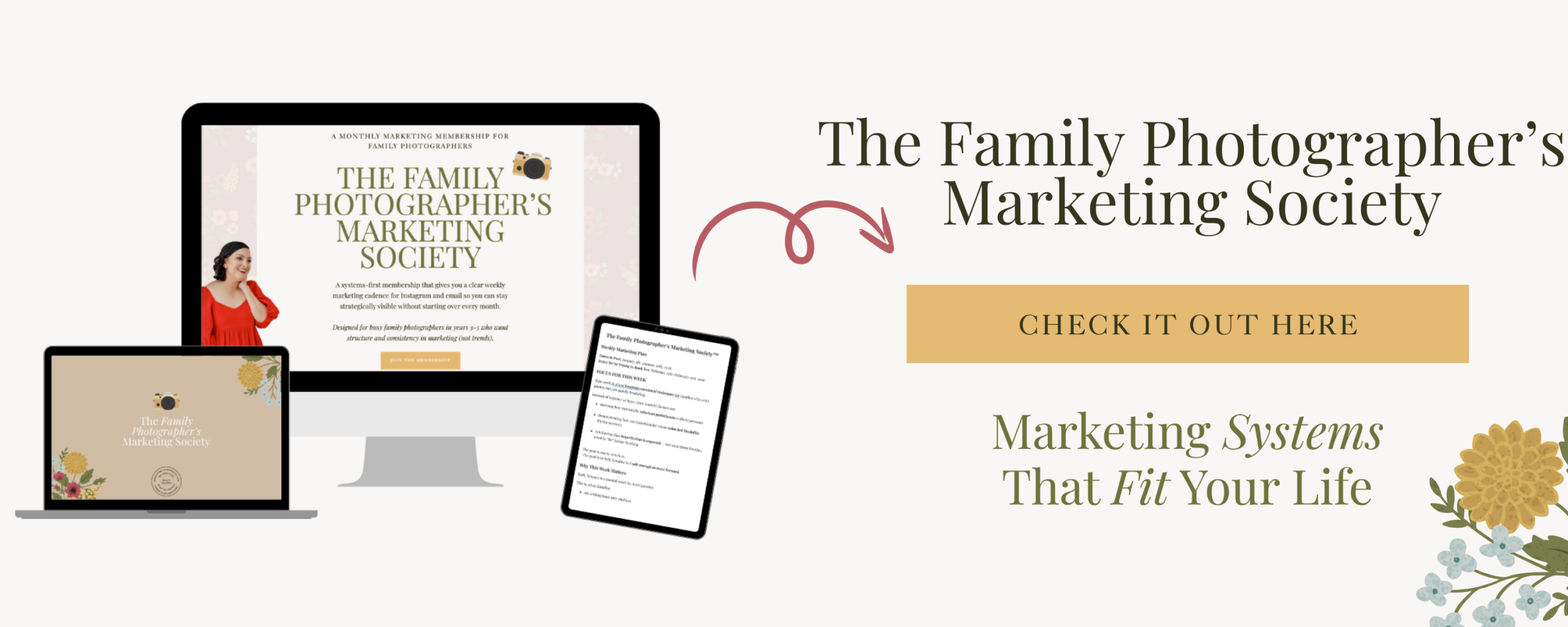
And if you want the exact planning structure I use to map out marketing months in advance, including how I plan around bigger sales pushes like Black Friday, that is the entire backbone of The Family Photographer’s Marketing Society. We map out email and content plans together, six weeks ahead, every single week.
Where to Learn More From Allison Hardy
Allison is going deeper into this exact case study, including the actual emails she sent and the timeline she followed, at the 2026 Black Friday Summit I am co-hosting with Mara Kucerak and Becca Reed, happening August 25 through 27, 2026. It is a free ticket, and if you are catching this post after the event, that same link will always lead you to sign up details for the next one.
You can also hear more from Allison on her podcast, Email Empire, and go back and listen to her previous appearance on this podcast about Black Friday launch prep and email marketing. Her website is allisonhardy.com, and you can find her on Instagram as well. (Note to Dolly: please confirm Allison’s exact Instagram handle spelling before publishing, since the audio transcription was unclear.) Remember, sign up and get your free ticket here (or get on the waitlist for next year’s Black Friday Virtual Summit).
Frequently Asked Questions About Black Friday Email Marketing
Do I need a digital product to run a successful Black Friday email campaign? No. Service providers can use the same waitlist and email cadence strategy to presell sessions, packages, or availability for a slower season instead of a digital product.
How early should I start writing my Black Friday emails? Most of your sequence can be written and scheduled by late September or early October, even if the launch itself does not open until November.
What is the biggest mistake business owners make with Black Friday emails? Waiting until the last minute to decide on the offer, which leaves no time for a waitlist, pre-launch content, or objection handling before the sale opens.
Does a small email list still make Black Friday worth it? Yes. Even a list of fifty or one hundred engaged subscribers can convert well when the offer, timeline, and objections are communicated clearly and repeatedly.
Meet Your Favorite Marketing Strategist and Business Coach for Family Photographers (Dolly DeLong Education)

Hi, I’m Dolly DeLong, a Nashville-based family photographer, marketing strategist, and systems educator for family photographers who want structure, clarity, and consistency in their marketing.
My photography journey began in 2006, and over the years, I built a sustainable family photography business while navigating motherhood, client work, and the realities of running a solo creative business. Along the way, I discovered something unexpected: I loved the backend just as much as the creative side.
What started as organizing my own workflows turned into helping other family photographers simplify their marketing, build repeatable systems, and stop relying on last-minute posting or panic marketing.
Today, I focus exclusively on helping family photographers intentionally market their businesses (not with trends but with consistently showing up).
I offer two ways to work with me:
-
The Family Photographer’s Marketing Society: a systems-first membership that provides a clear weekly marketing cadence for Instagram and email, so you always know what to focus on without starting over.
-
1:1 Strategic Marketing Support for established family photographers who want hands-on guidance in building a sustainable, SEO-supported marketing system.
Through my blog, podcast, and YouTube channel, I teach family photographers how to think like marketers, plan ahead, and create marketing rhythms that support both their business and their family life.
I still photograph families around Nashville because it’s one of my greatest joys. But helping family photographers build calm, consistent marketing systems that actually fit real life is a close second.
I’m so glad you are here, reading this blog, listening to the podcast, or watching the embedded YouTube video. I hope this educational content was helpful. Please let me know what future systems content you would like me to create!
more on me • more on me

More about dolly
Hi, I’m Dolly — a family photographer, marketing strategist, and systems & workflow educator for family photographers who want to find joy (and order) in their business again. Because I still work behind the camera, I understand firsthand how overwhelming the backend of a creative business can feel.
With my launch-strategist brain and a deep love for simple systems, I help photographers build intentional marketing rhythms and workflows that make it easier to show up consistently, attract the right clients, and actually enjoy running (and marketing) their business.
Through my blog, podcast, and YouTube education, I share actionable steps, real talk, and encouragement — all rooted in faith and intention — to help you bring clarity and confidence to your marketing and everyday systems. Because sustainable growth isn’t built on hustle or speed, but on thoughtful planning, consistency, and care.
part cheerleader. part systems guide.
But all dolly.
I'm Dolly

Watch now
This training covers the elements you should include in your photography business contact form.
How to create a contact page that WOWS & converts
no 03. | free training

Download now
Access my exact checklist I use to create my mini sessions every year in Dubsado
The Dubsado
Mini-Session Master Workflow Checklist
no 02. | DOWNLOAD

Get the free guiide
These evergreen posts build confident & consistent marketing
5 Instagram posts every family photographer should be sharing
no 01. | download